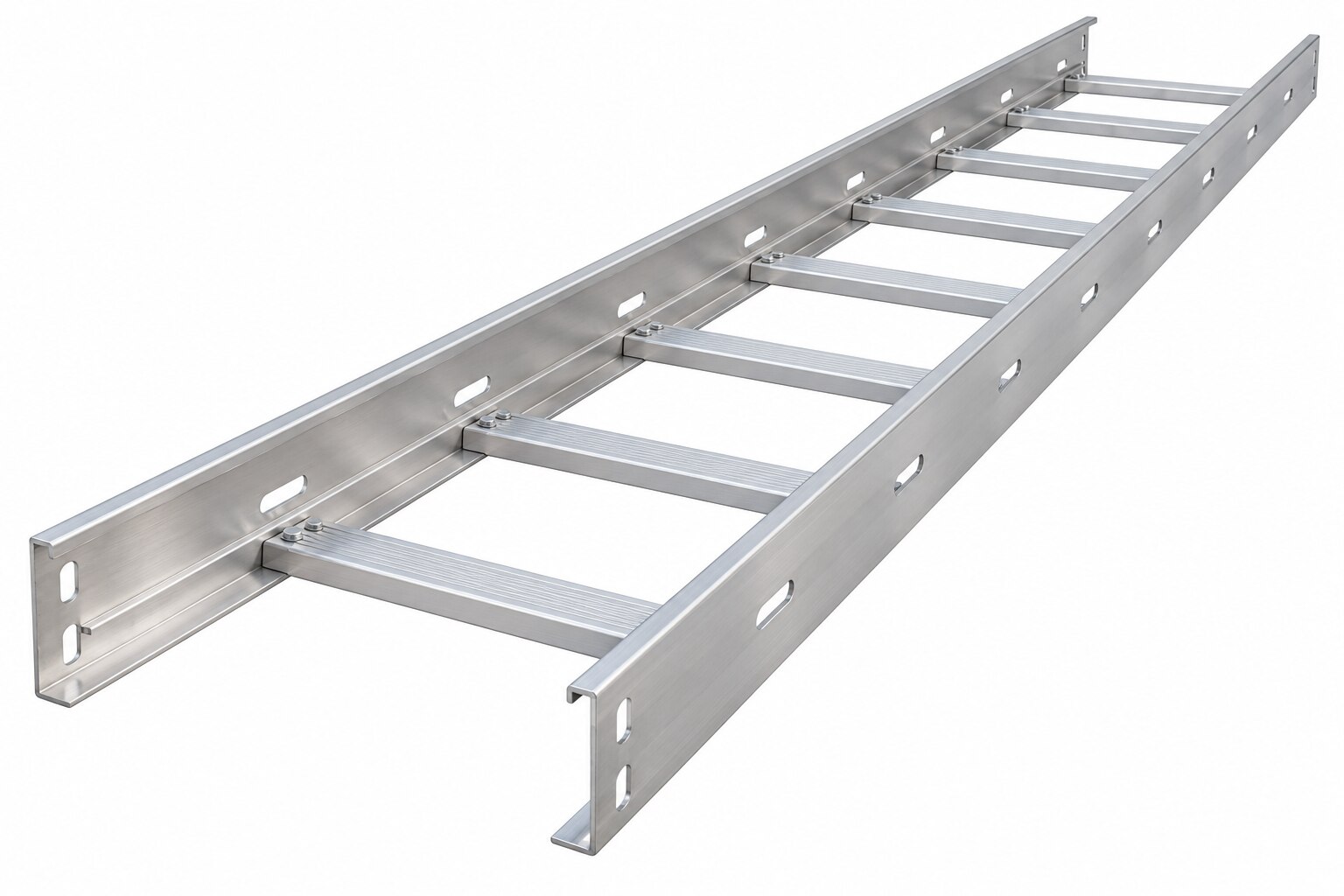
An aluminium ladder tray is useful only when its lower mass and corrosion behaviour solve a defined installation problem without compromising span, load, bonding or expansion requirements. By checking the alloy, environment, structural data, interfaces and documentation, you can decide whether aluminium is a sound alternative to steel for a particular cable route.
Key takeaways
- Aluminium weighs about one-third as much as steel at equal tray geometry.
- Use aluminium in wet, coastal or chemically exposed areas after checking the corrosion conditions.
- Compare load ratings using span, support spacing, deflection and safety-factor data.
- Request alloy, finish, dimensions, load tests and traceable quality documents before purchase.
What weight advantage does aluminium provide on a real installation?
At equal tray geometry, aluminium weighs about one-third as much as steel: its density is approximately 2.7 g/cm³, compared with 7.85 g/cm³. That makes aluminium ladder cable tray weight useful on roof work, where fewer people can lift sections, carry them through access routes and position them without lifting equipment.
Transport loads and installation labour also fall.
| Option | Density and practical effect | Comparison point |
|---|---|---|
| Aluminium | About 2.7 g/cm³; easier manual handling and roof access | Aluminium versus mild steel tray |
| Mild steel | About 7.85 g/cm³; greater lifting and transport demand | Base-material comparison |
| Pre-galvanized steel | Similar steel mass; zinc coating adds little weight reduction | Pre-galvanized steel comparison |
| Hot-dip galvanized steel | Similar steel mass; the heavier coating does not change the basic ratio | Hot-dip galvanized steel comparison |
The installed saving is less than two-thirds when the aluminium design uses thicker members, altered rail profiles, extra supports or heavier fittings. Compare complete system weights, not density alone.
Ask for the material designation and temper. A 6061 aluminium alloy offers higher strength, especially in T6 temper, while a 6063 aluminium alloy forms and extrudes more readily for architectural profiles; temper changes strength and formability, and both rely on an oxide film for atmospheric corrosion resistance.
Confirm the certificate, mill marking and cross-section: a steel tray with a coating is not aluminium, even if a catalogue calls it an aluminium tray.
Which environments justify aluminium, and where can corrosion still start?
Aluminium corrosion resistance is a practical advantage where wet air, not constant chemical immersion, is the main threat. A coastal cable tray on an outdoor roof, a high-humidity room or a wastewater area can retain a sound oxide film longer than unprotected carbon steel, reducing routine rust maintenance.
| Environment | Why aluminium helps | Where attack can start |
|---|---|---|
| Coastal salt exposure | Resists general atmospheric rusting | Chloride deposits can cause pitting |
| Outdoor roofs | Handles rain and humid air without red rust | Standing water, salt spray and damaged finish |
| High-humidity rooms | Oxide film protects exposed surfaces | Condensation trapped under fittings |
| Wastewater areas | Useful against damp, oxygen-rich air | Wastewater corrosion in an aluminium tray increases with chemicals and retained sludge |
| Selected chemical plants | Suitable where the chemical compatibility review permits it | Acids and strong alkalis can dissolve or disrupt the oxide film |
Treat the film as protection, not immunity. Chloride pitting, acidic or alkaline attack, contaminated cut edges and field-drilled holes can create local failures. A chemical plant cable tray needs a compatibility check against the actual vapours, liquids and cleaning agents.
Galvanic corrosion aluminium and copper, aluminium and galvanized steel, carbon steel or stainless-steel hardware becomes a risk when rainwater, condensation or salt solution bridges the metals. Dry indoor contact is far less severe than a continuously wet joint.
Control the interfaces:
- Specify compatible fasteners and use isolation washers.
- Add separation layers between dissimilar metals.
- Avoid water traps; slope or drain tray sections.
- Seal or protect interfaces exposed to spray.
- Repair coatings after drilling or cutting, especially at contaminated edges.
How do you compare aluminium and steel tray load ratings?
Equal width does not mean equal structural capacity. Aluminium has an elastic modulus of about 69 GPa, compared with roughly 200 GPa for steel, so an identical aluminium rail deflects about three times as much under the same elastic loading. Excessive sag can reduce clearance, load splice joints and create misalignment at bends.
| Comparison input | Why it changes the result |
|---|---|
| Tray width | A wider tray increases cable load and rail bending demand |
| Side-rail profile and height | A deeper or stiffer rail resists deflection better |
| Rung spacing | Closer rungs improve cable support but add system weight |
| Tray thickness | More metal increases stiffness and resistance to local damage |
| Cable weight | The distributed load determines the basic bending demand |
| Concentrated load | A person, tool or cable bundle can create a local peak load |
| Support spacing | Longer spans produce greater bending and deflection |
| Orientation | Horizontal, vertical and ceiling-mounted arrangements behave differently |
| Splice arrangement | Joint location and splice strength affect continuity across spans |
| Permissible deflection | The project limit determines whether calculated sag is acceptable |
Use the manufacturer’s span table and stated system load class to establish aluminium tray load capacity and aluminium cable tray allowable span. A steel ladder tray comparison based only on material density or nominal width is unsafe.
Replacing steel with aluminium requires a fresh calculation using the actual rail profile, accessories, support spacing, cable weight and concentrated load. The span table, not density alone, governs selection.
What should an aluminium tray purchase specification and test file contain?
A purchase order must identify the complete aluminium ladder system, not just its width. Require the supplier to name the actual base material, such as 6061 or 6063 aluminium, and its temper; “aluminium finish” alone does not prove construction.
- Specify the tray alloy, temper, finish, tray width, straight-section length, side-rail height, rung spacing and metal thickness. State the required covers, bends, tees, reducers, risers, splice plates and support hardware.
- Request system load tables showing the applicable load class, allowable spans, support spacing, installation orientation, concentrated-load limits and deflection criteria. Ask for splice details, expansion-joint provisions and compatibility instructions for fasteners, supports and dissimilar metals.
- State IEC 61537 in the aluminium cable tray specification. Add NEMA VE 1 where the project requires it, or name the project-specific Indian cable tray standard instead of leaving compliance ambiguous.
The cable tray test documents should include a conformity statement, mechanical-load test results, electrical continuity and bonding certification or other bonding evidence, corrosion-performance data, dimensional drawings and installation instructions. Verify continuity across every splice, fitting and expansion joint; a conductive tray is not automatically an approved protective-earth conductor.
Also reject unsupported claims that a metallic aluminium tray is fire-rated. Fire resistance and circuit integrity require a tested system under the project’s named standard. S.V. Metals & Extrusions Pvt. Ltd. can be considered when its aluminium tray material, accessory package and test documentation match these requirements.
Frequently asked questions
What weight advantage does aluminium provide on a real installation?
At equal tray geometry, aluminium weighs about one-third as much as steel because its density is approximately 2.7 g/cm³ versus 7.85 g/cm³. This reduces manual handling effort on roof work and through restricted access routes.
Which environments justify aluminium, and where can corrosion still start?
Aluminium suits wet, coastal and chemically exposed installations when its alloy and finish match the environment. Corrosion can still start at cut edges, damaged finishes, trapped moisture, deposits and contact points with dissimilar metals.
How do you compare aluminium and steel tray load ratings?
Compare both trays at the same span, support spacing, tray width, cable load, deflection limit and safety factor. Do not compare load ratings without checking the test method and support arrangement.
What should an aluminium tray purchase specification and test file contain?
Specify alloy, temper, tray dimensions, rung spacing, finish, joint hardware, load requirement, span and deflection limit. Request drawings, material certificates, finish records, load-test results and inspection documents with traceable batch details.