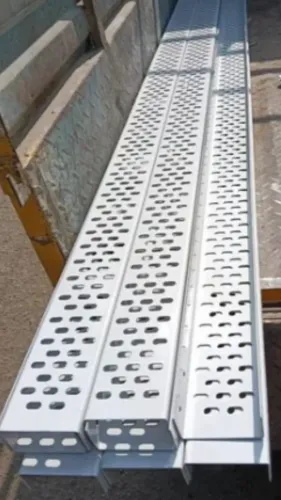
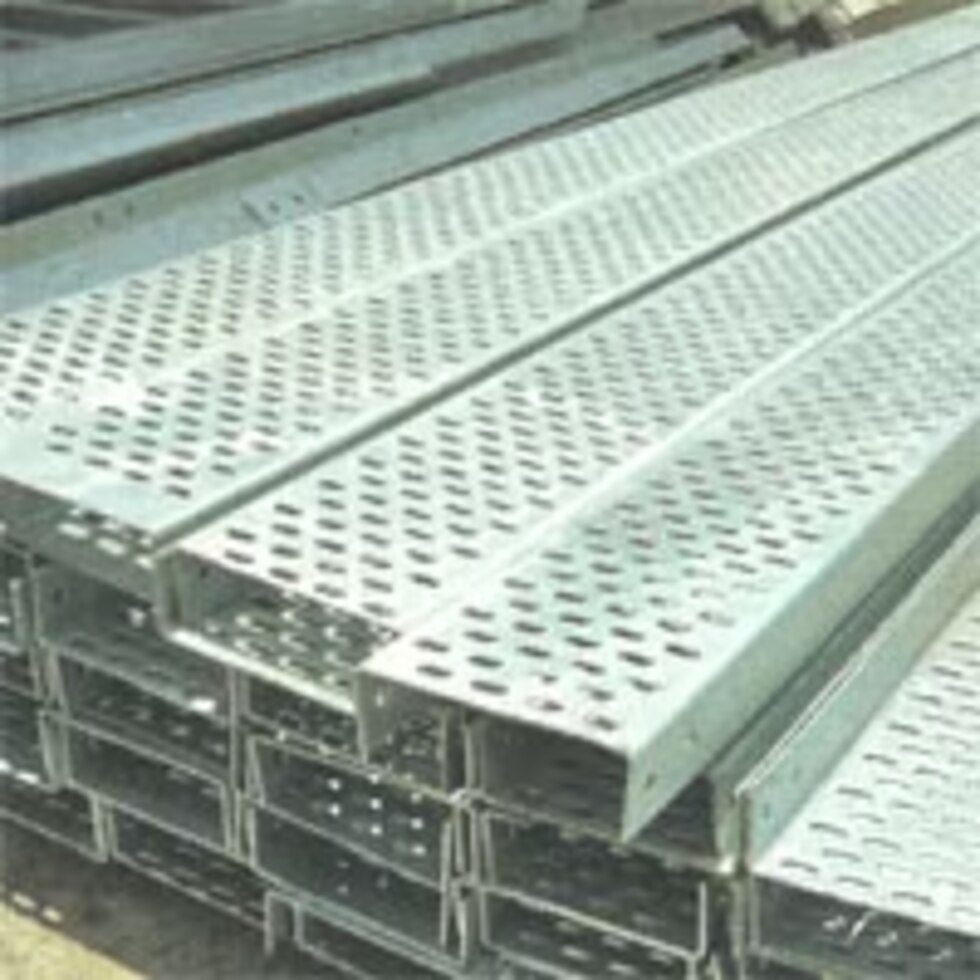
Direct sun can heat a steel tray far above the surrounding air, while monsoon water, pollution and thermal movement attack the finish and joints. By the end, you will be able to separate cable ampacity from tray strength, specify an outdoor finish, verify load capacity at the actual support span and compare manufacturers using a purchase-ready checklist.
Key takeaways
- Calculate cable ampacity separately from the tray’s mechanical load rating.
- Do not treat powder coating alone as proof of outdoor suitability.
- Verify tray width, support span, working load and deflection limits together.
- Specify bonding, covers, drainage and corrosion protection for exposed installations.
How hot weather changes cable and tray design
A mechanically rated tray is not automatically electrically adequate outdoors. In a perforated cable tray hot weather installation, direct sun can make dark steel materially hotter than the design air temperature, especially in Greater Noida. Calculate cable ampacity separately using design ambient temperature, solar exposure, grouping, installation arrangement and conductor-insulation limits.
A 90 °C XLPE cable does not automatically permit continuous operation at 90 °C. Terminations, lugs, glands, protective devices and other circuit components can have lower temperature limits. Tightly grouped cables dissipate less heat, while a cover can trap additional heat; include both conditions in the thermal calculation.
Use these checks before approving the tray:
- Apply the cable manufacturer’s correction factors for ambient temperature, cable grouping and the actual tray arrangement.
- Compare shaded ambient air temperature with the exposed tray surface temperature; they are different design inputs.
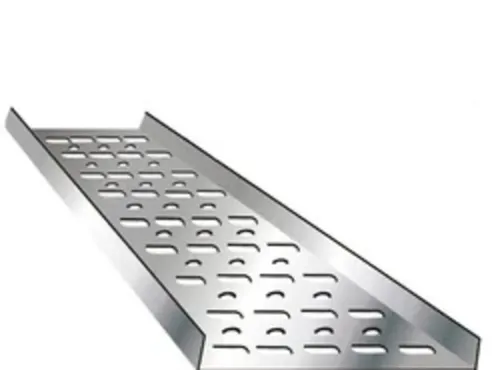
- Treat perforations as aids to rainwater drainage and ventilation, not as proof of current-carrying capacity.
- Recalculate if a cover, dense cable bundle or altered spacing is added.
| Condition | Temperature basis | Design consequence |
|---|---|---|
| Shaded tray | Project design ambient air temperature | Apply ambient and grouping factors. |
| Dark steel in direct sun | Exposed metal surface can exceed shaded ambient | Use the project’s solar-exposure basis for ampacity. |
| Covered, tightly grouped cables | Heat dissipation is restricted | Apply the required derating; a mechanical load rating does not prove electrical suitability. |
Which finish survives sun, rain and industrial exposure
Powder coating is suitable for outdoor use only when its chemistry and preparation match the exposure. Direct sun, monsoon rain and industrial pollution can cause outdoor polyester powder to chalk, lose gloss or degrade; damaged areas then corrode.
| Option | Exposure behaviour | Safer application |
|---|---|---|
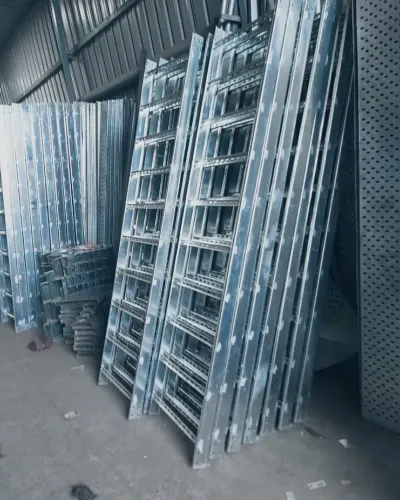
| Hot-dip galvanizing | Thicker zinc normally provides sacrificial protection at scratches and exposed edges. | General outdoor industrial exposure, including rain and humidity. |
| Pre-galvanizing | Factory zinc protects intact sheet, but cut edges, drilled holes and site-welded joints need separate treatment. | Controlled fabrication with specified edge repair. |
| Painted MS | Paint shields steel, but scratches, welds and standing water expose bare steel quickly. | Dry, inspectable locations with a defined primer, topcoat and repair system. |
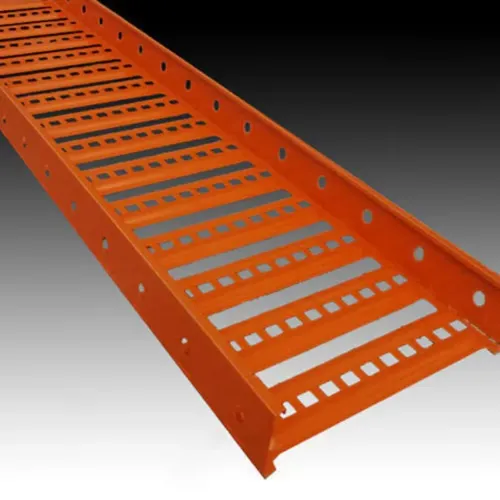
| Powder coating | Good barrier finish when bonded to prepared steel, but UV, impact damage, holes and cut edges remain failure points. | Outdoor use only with a complete coating specification. |
A purchase specification that says only “GI tray” is incomplete. Name hot-dip or pre-galvanizing, the zinc coating requirement, and the repair method.
Before approving a powder coated tray outdoor use application, require:
- Powder chemistry and coating thickness
- Pretreatment and the UV/weathering requirement
- Repair materials and field-repair procedure
A galvanized-and-powder-coated duplex system needs compatible preparation. Poorly cleaned or passivated zinc can cause blistering, adhesion failure and under-film corrosion.
Choose stainless steel or aluminium for persistent moisture or aggressive chemicals, not as automatic upgrades. Check continuity across painted joints, splice hardware and site welds; add approved bonding hardware where the coating interrupts the protective path.
How to verify tray width, span and working load
Choose the tray from the cable arrangement, not the largest number on a catalogue label. Count the cables, record each diameter and mass per metre, calculate the required width from the layout and separation, then add future spare capacity.
Select side-rail height for the cable depth and decide whether covers are needed for rain, dust, birds or falling objects.
- Ask a cable tray manufacturer for outdoor wiring to provide its load-versus-span table for the exact sheet thickness, perforation pattern, tray width, side-rail height and support spacing.
- Confirm the permissible deflection limit and whether the published rating is a working load or a failure load.
- Check the splice plates, covers and accessories as part of the tested assembly.
Perforation improves drainage but reduces section capacity compared with a solid-bottom tray. A generic kilograms-per-metre claim is not enough.
| Condition | Why the rating changes | Required check |
|---|---|---|
| Splice between supports | The joint can interrupt the load path | Use the manufacturer’s joint-position data |
| Longer support span | Bending and deflection increase | Use the actual span |
| Heavy cable bundle | A concentrated load can exceed uniform-load assumptions | Obtain a concentrated-load check |
| Covers and accessories | Added mass increases tray load | Include their documented weights |
Multiply every cable’s mass per metre by its loaded length, add the mass of covers and accessories, and compare the total with the tabulated working load at the actual support spacing. Do not approve the tray until that comparison also respects the stated deflection limit.
What the outdoor installation must include beyond the tray
Beyond the tray, install a support, drainage, movement and bonding system that matches the cable load and outdoor exposure.
1. Set cantilever brackets or trapeze supports at the manufacturer’s rated span, not at a convenient site spacing. Use cantilevers for accessible wall-mounted routes and trapezes where the tray is suspended or carries wider loads. Add support below bends, tees and joints, and prevent unsupported vertical cable runs from loading terminations.
2. Allow for movement. Carbon steel expands about 12 × 10⁻⁶ per °C; a 100 m run exposed to a 40 °C change can move approximately 48 mm. Use expansion joints, sliding supports or the manufacturer’s specified joint detail on long exposed runs.
3. Install the perforations to drain rainwater and prevent debris pockets. Provide inspection access, and fit covers where falling objects, bird nesting, dust or direct rain justify them. Include each cover in thermal-dissipation and load calculations because it adds weight and can trap heat.
4. Keep every cable within its specified minimum bend radius, align tray sections without sharp offsets, and secure cables with ties or cleats suited to the environment. Bond across ordinary joints, painted or powder-coated interfaces and expansion joints; test continuity after installation because coatings, rust and loose splice hardware can interrupt the path.
5. Separate power, control, instrumentation, telecom and photovoltaic cables in separate trays or with metallic dividers when voltage, electromagnetic compatibility, safety or project standards require separation.
How to compare a Greater Noida tray manufacturer before ordering
A purchase specification for a perforated cable tray manufacturer for hot weather installations in Greater Noida must describe the tested configuration, not just “heavy duty” or “GI.” Identify:
- Tray type, width, side-rail height, sheet thickness and perforation pattern
- Support span, permissible working load and deflection limit
- Finish system and coating test method
- Splice plates, bends, tees, reducers, covers, supports and earthing accessories
Ask the perforated tray supplier in Greater Noida for load-versus-span data covering that exact configuration. Request finish-repair instructions and written confirmation that every fitting preserves the tested load path; an untested splice or field-modified bend can invalidate the rating.
Compare the engineering response, not a catalogue claim alone.
| Evidence to compare | Acceptable response | Warning sign |
|---|---|---|
| Load capacity | Table states width, rail height, thickness, perforation, span and working load | Generic kilograms-per-metre figure |
| Finish | Process, coating thickness, test method and repair procedure are named | “Durable outdoor finish” |
| Corrosion review | Addresses direct sun, monsoon rain, standing water, pollution, humidity, coastal exposure and chemicals | One finish recommended for every site |
S.V. Metals & Extrusions Pvt. Ltd. can be considered when one Greater Noida source needs to discuss perforated tray fabrication, fittings, steel finishing and related supports against these project inputs.
Related products
 | GI Tray ₹100 We offer the most extensive range of perforated type cable trays, which are used for the installation of cables, smaller & controlled cables. View product → |
 | Hot Dip Galvanized Perforated Type Cable Trays ₹98 We are widely known for designing Hot Dip Galvanized Perforated Type Cable Trays that are highly durable and the holes provide necessary ventilation. View product → |
Frequently asked questions
How does hot weather affect perforated cable tray installations?
Direct sun can heat dark steel above the design air temperature. Recalculate cable ampacity for ambient temperature, solar exposure, grouping, installation arrangement and conductor-insulation limits.
Is a powder-coated tray suitable for outdoor use?
Check the coating system, pretreatment, UV exposure, rain, industrial pollutants and any cut-edge protection. Powder coating alone does not prove outdoor suitability.
How do you verify tray width, span and working load?
Add cable fill and future capacity, then match the tray’s published working load to the actual support span. Check the manufacturer’s load tables, deflection limits and splice requirements.
What does an outdoor cable tray installation need beyond the tray?
Plan covers where water, falling objects or sunlight create risk, provide bonding and earthing, protect penetrations, allow drainage and seal or treat cut edges against corrosion.
How should you compare a Greater Noida perforated tray supplier?
Compare material grade, finish system, load tables, test documents, fabrication tolerances, accessories, delivery capability and technical support rather than price alone.
Related products
 | MS Painted Perforated Type Cable Trays ₹108 Our company is engaged in offering supreme quality MS Painted Perforated Type Cable Trays that are widely used for providing circulation of cables... View product → |
 | Powder Coated Perforated Type Cable Trays ₹101 We are offering Powder Coated Perforated Type Cable Trays that are used in industries, metro stations, office buildings, schools etc. View product → |
 | Pre Galvanized Perforated Type Cable Trays ₹99 Pre Galvanized Perforated Type Cable Trays are widely used for power circulation in residential buildings, commercial complexes, institutes,... View product → |
 | Cable Trays & Accessories Bends for Perforated Cable Trays Finish : Painted, Powder Coated, Hot Dip Galvanized, Natural MOC : MS, GI, Aluminium View product → |
Keywords